Anúncios
Adopting a large dog can be a rewarding way to add a companion to your family, but the goal is not simply to find a dog that looks right. The goal is a stable match between a specific dog and the people, routine and environment that will become their home. Start by agreeing what your household can offer every day before you fall in love with a profile.
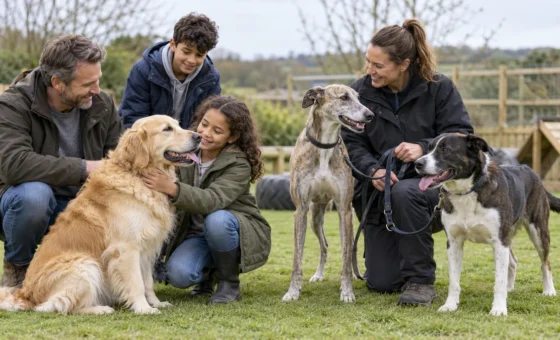
For a useful size reference, Dogs Trust places large dogs between 25kg and 45kg and names Labradors, greyhounds and Siberian huskies in that group. This tells you to plan for physical handling and space, but it does not decide suitability. A large dog can have lower or higher activity needs than another dog of a similar weight.
On this page
If you are considering a Labrador, the Royal Kennel Club calls the breed versatile as a family companion, service dog, guide dog and working gundog. Its profile also identifies it as a large breed with more than two hours of exercise per day in its listed characteristics. That is helpful background, not a substitute for speaking to a rescue about the particular dog’s needs.
A rehoming charity can help turn those general ideas into a practical assessment. Woodgreen says its team considers a dog’s needs and an applicant’s unique circumstances rather than excluding people under blanket rules. Describe your household plainly, including children, other pets, work patterns, access to exercise and any limits on handling or travel.
Ask direct questions before applying or meeting a dog. Dogs Trust suggests asking about exercise, house training, behaviour around children, other animals, time left alone and behaviour during walks. The answers are more useful when you compare them with your actual week, including school runs, shifts, holidays and who takes responsibility when plans change.
You will leave for an external site. Official portal. Free access.
Prepare your family before you search
Make the decision as a household. Agree who is responsible for morning and evening walks, feeding, training sessions, appointments and care if the main carer is unwell or away. Children can take age-appropriate roles, but an adult should remain responsible for supervision and the dog’s welfare. A clear plan also makes it easier to explain your readiness to a rescue team.
Use a practical adoption checklist
- List your routine Note working hours, school runs, exercise time, travel and who can step in when plans change.
- Set safe boundaries Decide where the dog will sleep, eat, rest undisturbed and how introductions to children, visitors and pets will be supervised.
- Read each profile Look for stated exercise, handling, training and home-environment needs rather than choosing from a photo or breed name alone.
- Ask the rescue Discuss the dog’s known history, health, behaviour, training and any support needed after rehoming.
- Meet and reflect After a match is proposed, consider whether the dog’s needs and your family’s capacity genuinely align before proceeding.
What a good match can involve
A good match is specific. One large dog may be comfortable with older children but not younger ones; another may need a quieter street, a secure garden or a home without other pets. Do not treat these needs as a judgement on your family. They are useful details that help the rescue place each dog where they are most likely to settle well.
Give an adopted dog time to settle
Keep the first days predictable: establish calm feeding, walking and rest routines, follow the rescue’s advice and avoid expecting instant confidence. Woodgreen explains that adopted dogs can take weeks or months to adjust, and some may need ongoing training indoors and outdoors. If challenges arise, ask the charity or a qualified professional for guidance early rather than waiting for routines to become harder to change.
A final check before you commit
Before you submit an application, revisit the essentials: can your household meet the dog’s daily needs, manage their size safely and continue training with patience? If the answer is uncertain, tell the rescue. A different dog, a later time or fostering may be a better route than forcing a match that does not fit.
Frequently asked questions
Can I adopt a large dog if I have children?
It can be possible, but the rescue will need to assess the individual dog and your household. Be clear about children’s ages, your supervision plan and the dog’s observed behaviour around children.
Do I need a garden to adopt a large dog?
Requirements vary by dog. Woodgreen says it has rehomed dogs to flats and homes without gardens, while noting that a garden is essential for some dogs but not others.
What should I ask about a rescue dog before adoption?
Ask about their history, health, exercise, house training, behaviour with children and other animals, time alone, walking behaviour and any training or management they need.
How long does a rescue dog take to settle?
There is no fixed timetable. Woodgreen says settling in could take several weeks or even months, so give the dog consistent routines and follow the charity’s guidance.